FIB Unhas — The demand to adapt to an outcome-based higher education system (OBE) is increasingly prominent, especially following the issuance of the Minister of Higher Education, Science, and Technology Regulation Number 39 of 2025 concerning Quality Assurance. Responding to this need, the Association of Indonesian Arabic Language and Literature Study Programs (IQLAB) held a National Workshop on OBE-based Curriculum.
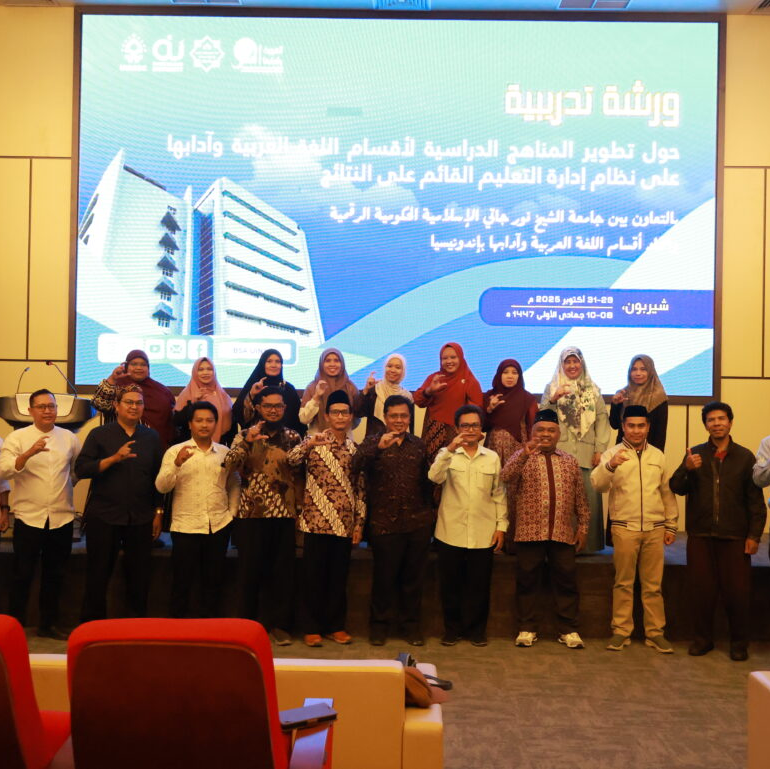
The event, which lasted for three days from October 29–31, 2025, was centered at the State Islamic University (UIN) Siber Syekh Nurjati Cirebon, West Java. This workshop was a collaboration between IQLAB and the Faculty of Ushuluddin and Adab at UIN Siber Syekh Nurjati Cirebon.
No less than 19 Arabic Language and Literature (BSA) study programs from various universities—both under the auspices of the Ministry of Higher Education, Science, and Technology (Kemdiktisaintek) and the Ministry of Religious Affairs—participated. The presence of these study program managers became an important forum to align steps and formulate minimum standards for the OBE curriculum in the field of BSA studies.
The workshop opening took place in the Auditorium of the Siber SBSN Building, 8th floor. In his remarks, the Vice Dean I for Academic Affairs of the Faculty of Ushuluddin and Adab, Dr. Wakhid Nashruddin, emphasized the urgency of curriculum adaptation.
“This curriculum review is not just an administrative fulfillment,” said Dr. Wakhid. “This is our collective strategic step to ensure that BSA graduates are not only fluent in the language but also highly competitive and relevant to the ever-changing demands of the times.”
After the opening, participants were immediately involved in intensive discussions and the drafting of the curriculum. The focus was on sharing best practices in determining learning outcomes, assessment methods, and compiling outcome-based quality documents.
As a concrete follow-up, the workshop agreed to form a national team to compile the OBE Curriculum Guidelines for Arabic Language and Literature Study Programs in Indonesia. These guidelines are expected to become a common reference for creating BSA curricula that are more contextual, measurable, and innovative throughout Indonesia.